
The decision on dates for a storm observing/chase trip is not an easy one, when one does not live in the Great Plains. We must constantly juggle possible plane reservations against whether nor not the patterns will be favorable.
As of 15 May 2017, medium range models (the ones that go out 384 hours) are fairly consistent in shutting out the 20 – 23 May period. Beyond May 23rd, the Global Ensemble Forecast System (GEFS), which makes 21 tries at forecasting a pattern by slightly varying the initial conditions, still has five or six solutions that are favorable for the southern Plains. It even has the solutions further north have an undercutting subtropical branch of the polar westerlies coming across that area gradually through early to mid next week.
By the Memorial Day weekend the solutions either have a strong disturbance with favorable central and southern Plains parameters coming in Thursday or Friday, or not. But what the GEFS and another one of the models, this one going out much further into the future, the Coupled Forecast System (CFSv2 )”think” will happen is there for, at least in the subtropical branch, there to be adequate deep layer shear and CAPE.
Here’s the forecast way out into the future for Sunday 28 May CDT showing the region in which the GEFS “thinks” juxtaposition of favorable fields of deep layer shear, low level shear favorable for rotating updrafts, and buoyancy will occur. Vapes of 2 or so or more indicate very favorable parameters for supercells in that region. Whether storms will initiate is a separate issue.
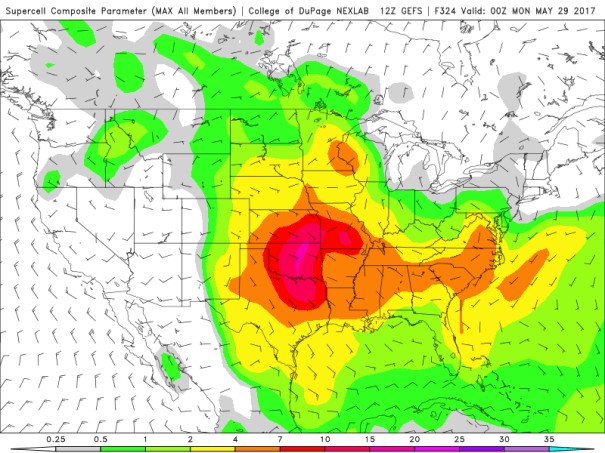
Fig. 1: Supercell Composite Parameter (SCP), ensemble mean, GEFS, 7PM CDT, 28 May 2017.
Another way of looking at this through 384 h (16 days) and beyond comes from the CFSv2. Each forecast day has a color that represents the number of points (out of 845 across the United States) that the SCP is favorable, from deep blue (little to none) to red in numbers of favorable points. White outlined boxes have favorable conditions at more than 100 of the points, and X’s inside the box indicates that SCP values have exceeded extreme magnitudes at at least one of the points.
Here are chiclets from the 0000 UTC CFSv2 run of 0000 UTC 15 May. The graph lines show the total number of points at which the average value of SCP is forecast, and the colored lines the number of points exceeding low and extreme values, etc. The black line suggests an active period starting around the 24th or so.
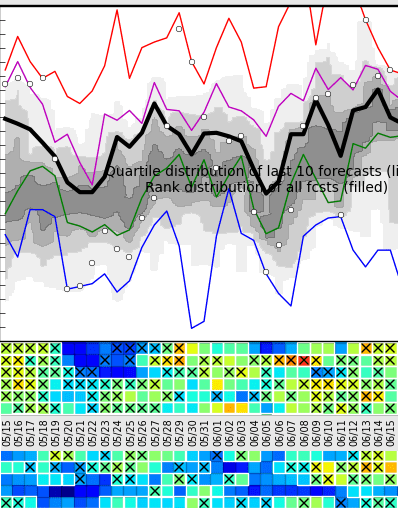
Fig. 2: CFSv2 chiclets, as explain above from May a5 through June 15.
There has been enough consistency for us to change our flights to inbound to Denver on 26 May and outbound, variable, but nominally 1 or 2 June.
 Supercell Whispers 2020